Cine


El cantante Jhosemaria De Niro habló sobre el impacto cultural de la vestimenta tradicional, la viralización de su estilo “gauchesco” y las repercusiones que generó la aparición de John Travolta en el Festival de Cannes con una estética similar. También reflexionó sobre la moda, la identidad y la uniformidad cultural impulsada por las grandes corporaciones.
— John Travolta caused a sensation at this year’s Cannes Film Festival for sporting a ‘Gaucho-style’ look. Immediately, the Head of Press at Tribeca New York Music posted on the company’s official website that you had a lot to do with this seemingly trivial or minor detail, namely the way a Hollywood superstar dresses, curiously following a style that has brought you a great deal of publicity. What can you tell us about this?
— I’m not important enough for John Travolta to take notice of me or the way I dress.
What is actually happening is something else entirely.
Our distributor informed us, and we made it public, that we have reached almost 42 million people.
This happy fact, combined with my stage name, has led many people to visit my Facebook pages, the only social media platform we use.
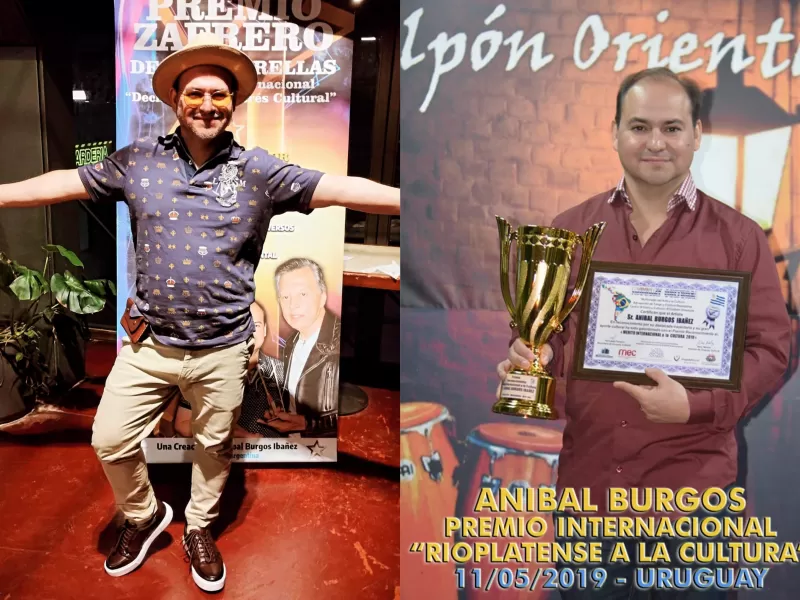
If we add to this the widespread circulation of articles and interviews online in which we addressed fashion and the massification that erases identities, as well as my decision to reclaim one of the strongest aspects of my identity, which is my Argentinian heritage, it becomes understandable that my photos are going around the world in the same way my songs do.
— Has John Travolta attended any of your concerts in the United States?
— Not as far as I know.
Some celebrities have attended discreetly, but we never boast about it.
What the staff at Tribeca New York Music told me is that several people connected to the image industry have praised the Gaucho appearance this clothing gives me.
Honestly, the traditional clothing of any culture is beautiful.
What surprises me is that people prefer to dress uniformly to “belong” to an international tribe, missing out on the elegance that their own culture usually provides.
Learn about the traditional clothing of Colombia, Venezuela, Mexico and many other countries.
It is hard to understand why people from those places follow such ugly and uniform trends, surely born in the workshops of the major retail chains we all know.
There are millions of Argentine, Uruguayan and Brazilian Gauchos.
I simply embraced and reclaimed that image without being a model and certainly not a young one.
I did it for my own satisfaction and desire.
I never thought I could set a trend.
I’m a singer, not an influencer.
My attitude confused many people, which is why I clarified that my childhood and youth took place in an area and period where gaucho culture was common.
I returned to my roots and I’m delighted that I did.
— Is it true that a particular way of dressing involves a huge number of sociological issues?
— Of course.
I’m not going to write a treatise on the Sociology of the Masses here, but certain themes can be identified in the way large masses of people dress.
The power of minorities that decide how others should dress.
The power those minorities have to create fear of being excluded from what is collectively accepted.
The general depersonalisation that allows large corporations to sell whatever they want, whenever they want and however they want.
— Don’t you think that if Argentine fashion becomes dominant, it is also a way of influencing and standardising the masses?
— Nobody intends that.
What I do is reclaim my identity and send a message to the peoples of the West.
Reclaim the beautiful traditional clothing of the culture each of you belongs to.
Diversity and difference make life more beautiful.
Many people also know about my absolute rejection of extreme uniformity, whether in the way we dress, cut our hair or, more importantly, in the way we think.
Life is diversity.
Nature teaches us that.
Let us try to read what God has placed before our eyes.